Beyond the Beach: Why Phuket Town Is Quietly Becoming Thailand's Most Compelling Investment Address
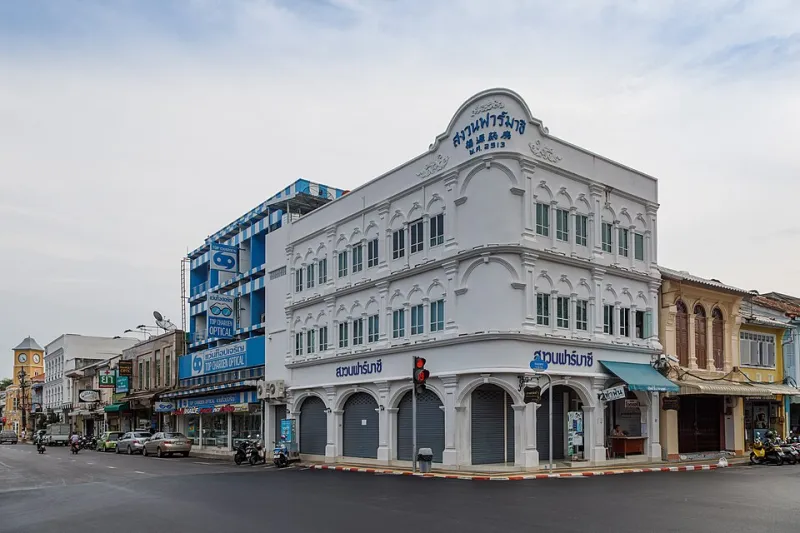
Photo: CEphoto, Uwe Aranas, CC BY-SA 4.0, via Wikimedia Commons
For decades, the playbook for buying property in Phuket followed a single, well-worn script: get as close to the water as possible, pay whatever the market demands, and hope the tourist tide keeps rising. Patong Beach condominiums and Kata villas have long dominated the conversation among foreign buyers, and for understandable reasons — beachfront real estate carries an almost universal appeal. But a growing cohort of American investors is tearing up that script entirely, redirecting their capital toward a destination that many travelers drive straight through on their way to the coast: Phuket Town itself.
What they are finding there may surprise you.
The Case Against Conventional Wisdom
Phuket Town — the provincial capital situated in the southeastern portion of the island — is not a consolation prize for buyers who missed out on beachfront units. It is an entirely different investment thesis, one built on authenticity, accessibility, and a fundamentally different demand profile than the resort zones that dominate most property listings.
The town's Sino-Portuguese architectural heritage, recognized and celebrated by UNESCO, draws a distinct category of visitor: the culturally motivated traveler, the long-term expat professional, the digital nomad seeking reliable infrastructure rather than a sunset view. These guests tend to stay longer, spend more selectively, and return with greater frequency than the package-tour demographic that cycles through Patong's hotels every seven nights.
For the investor, that distinction matters enormously.
A Price-to-Yield Equation That Favors the Informed Buyer
Entry-level condominium prices in Phuket Town's central district currently run approximately 30 to 50 percent below comparable units in Patong or Kamala. A well-appointed one-bedroom unit in a modern Phuket Town development can be acquired in the range of $65,000 to $110,000 USD, while equivalent square footage closer to the beach frequently commands $150,000 or more — before factoring in the premium for an ocean-facing aspect.
Yet rental yields in Phuket Town are increasingly competitive. Properties managed through professional short-term rental platforms in the Old Town district are achieving gross annual yields in the range of 6 to 9 percent, according to data tracked by regional property consultancies. Long-term lease demand — driven by the town's growing population of expat professionals, healthcare workers affiliated with Bangkok Hospital Phuket, and educators at international schools — provides an additional layer of income stability that purely tourist-facing properties cannot replicate.
Michael R., a retired financial advisor from Austin, Texas, who purchased a two-bedroom unit near Dibuk Road in 2022, described his experience this way: "I looked at Patong first, like everyone does. But when I ran the actual numbers — purchase price, management fees, occupancy rates across twelve months rather than just high season — Phuket Town came out ahead every time. And I genuinely enjoy spending time there, which matters when you own a place."
Infrastructure Growth Is Not a Future Promise — It Is a Present Reality
Skeptics of inland Phuket investment sometimes raise concerns about connectivity and convenience. Those concerns are increasingly dated. Phuket Town serves as the island's administrative, medical, and commercial hub, meaning its infrastructure investment is driven by resident necessity rather than tourist seasonality.
The Central Festival Phuket shopping complex, one of southern Thailand's largest retail destinations, sits within easy reach of the town center. Bangkok Hospital Phuket — a internationally accredited facility that attracts medical tourists from across Southeast Asia — is located here. The town's Central Bus Terminal connects to the mainland, while the ongoing development of Phuket's light rail project, which includes a planned station serving the town's vicinity, signals continued governmental commitment to the area's long-term accessibility.
Road improvements, the expansion of co-working spaces, and a proliferating restaurant and café scene catering to both locals and international residents have transformed the town's walkability and livability profile over the past five years.
The Cultural Dividend
There is a dimension to Phuket Town investment that spreadsheets struggle to capture but that experienced property owners frequently cite: the quality of place. The Old Town's Thalang Road and Soi Romanee — with their restored shophouses, weekend markets, and independent galleries — offer an atmosphere that no resort development can manufacture. Authenticity, by definition, cannot be constructed from scratch.
For American buyers accustomed to evaluating neighborhoods in cities like Nashville, Portland, or Savannah, the parallel is recognizable: historic districts with genuine character consistently outperform sterile new developments in long-term value appreciation, even when initial yields appear similar. Phuket Town's Old Town is undergoing precisely that kind of organic revitalization, and early investors are positioned to benefit from the appreciation that typically follows cultural recognition and gentrification-adjacent development.
What Savvy Investors Are Watching Now
The developments attracting the most attention from informed buyers in 2024 and 2025 share several characteristics: proximity to the Old Town's commercial core without being directly on the most tourist-trafficked streets, modern construction standards with high-speed internet infrastructure built in, and management arrangements that accommodate both short-term and long-term rental strategies.
Units in newer residential towers within a fifteen-minute walk of the weekend market and the main Yaowarat Road commercial strip are seeing the strongest inquiry volumes on platforms like Condo Phuket Town, reflecting the market's recognition that location within the town — not merely location within Phuket — drives performance.
The Window Is Open, But It Will Not Stay That Way
Phuket Town is not undiscovered. It is, more precisely, undervalued — and that distinction has a finite lifespan. As international property media continues to surface the town's investment credentials, and as the Thai government's ongoing tourism diversification strategy channels visitors toward cultural destinations rather than purely coastal ones, the pricing gap between Phuket Town and the beachfront zones is likely to compress.
For American investors who have spent years watching similar dynamics play out in cities like Detroit's Corktown, New Orleans' Bywater, or Miami's Wynwood — neighborhoods where cultural authenticity preceded significant capital appreciation — the pattern will feel familiar.
The question is not whether Phuket Town represents sound investment logic. The evidence increasingly suggests that it does. The more pressing question is whether today's buyers will act before the rest of the market arrives at the same conclusion.
At Condo Phuket Town, our listings span the full spectrum of the town's residential market, from heritage-adjacent studios to multi-bedroom units suited to family relocation or professional tenants. We invite you to explore what the island's most underrated address has to offer — not as a fallback, but as a first choice.