The Walkability Dividend: Why Thalang Road Beats the Beachfront in Phuket Town's Rental Market
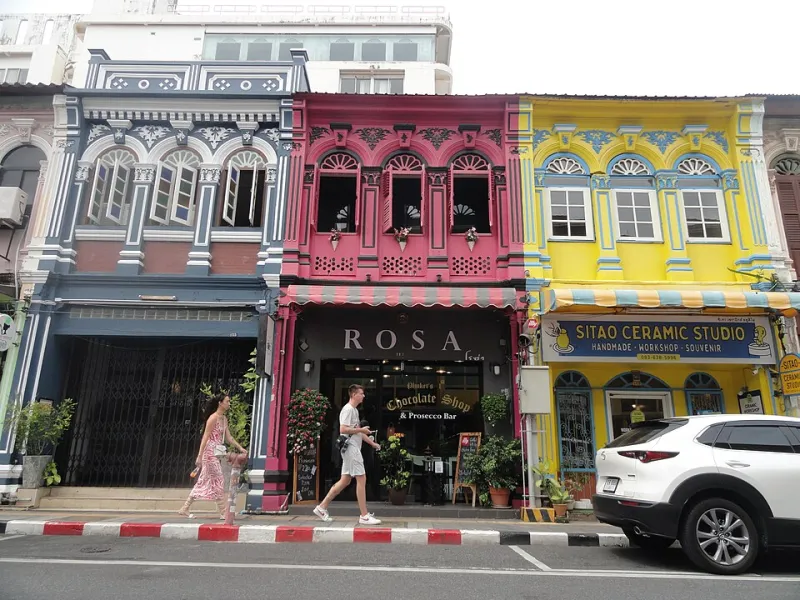
Photo: Ryomaandres, CC BY-SA 4.0, via Wikimedia Commons
The Location Metric That Nobody's Tracking
Ask any American investor what drives condo value in Phuket and you'll hear the same answers: beach proximity, sea views, tourist infrastructure. These were the right questions for the Patong era. But Phuket Town's rental market has evolved, and the metric that increasingly separates premium units from average ones isn't distance to the sand — it's distance to the sidewalk.
Walkability, long a buzzword in Austin and Portland real estate, has quietly become the strongest signal of rental durability in Phuket Town. And the data pattern is hard to argue with.
What Long-Stay Tenants Actually Want
The tenant profile in Phuket Town has transformed over the past five years. Digital nomads, remote employees, retired couples, and Thai professionals now dominate demand, and their priorities diverge sharply from the two-week tourist. They want to step out of their building and reach a specialty coffee shop, a co-working café, a Western-style gym, and a genuine restaurant scene without touching a car.
The Old Town delivers exactly this. Thalang Road and its surrounding sois offer a density of lifestyle amenities unmatched anywhere else on the island — the Sunday Walking Street Market (Lard Yai), the heritage shophouse district, indie galleries, and a café culture that rivals anything in Chiang Mai. A tenant who can walk to Sunday market and bike to work experiences Phuket as a livable city. One who needs a scooter for every errand experiences it as a logistics problem.
The Premium Is Real
Anecdotal evidence from Phuket Town landlords is remarkably consistent: units within a 10–15 minute walk of the Old Town core command higher occupancy and stronger long-term renewal rates than comparable units elsewhere in town, even when the Old Town units lack views. Renewal rates matter more than headline rent — a tenant who stays two years saves you two rounds of vacancy, cleaning, and listing fees.
There's also a resilience argument. Beach-adjacent rental markets swing violently with tourism cycles and, as recent history shows, with global disruptions. Walkable urban neighborhoods anchored by resident demand — students, professionals, retirees — hold occupancy through downturns because their tenants aren't tourists. They're neighbors.
Inside the Walkable Zone
Which projects benefit? The premium zone radiates outward from the intersection of Thalang, Dibuk, and Krabi roads. Condominiums within roughly a kilometer of the Old Town heritage district — the cluster of mid-rise projects between Phang Nga Road and the area approaching Central Phuket — sit squarely in it. Properties along the fringes, particularly those near the weekend market grounds and the main hospital corridor, capture much of the same demand.
What to verify before you buy: walk the route yourself at 6 p.m. on a Saturday. Check sidewalk quality, street lighting, and whether the cafés and restaurants you're counting on are independently busy or dependent on tourist buses. A five-minute walk on a map can be a fifteen-minute walk in the rain.
The Contrarian Case, Stated Plainly
The conventional wisdom says views sell condos. That remains true for the buyer's market. But in Phuket Town, lifestyle walkability rents them — consistently, year-round, to tenants who sign twelve-month leases and renew. For American investors optimizing for cash flow and occupancy rather than resale drama, the walkable zone around the Old Town may be the most undervalued location signal on the entire island. The postcard view is a nice bonus. The Sunday market around the corner is the return.